Extracorporeal shock wave lithotripsy (ESWL)
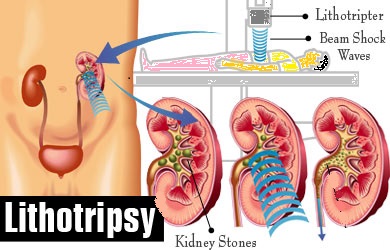
Extracorporeal shock wave lithotripsy (ESWL) uses focused sound waves to break kidney or ureter stones into smaller pieces so that they can pass out more easily. It is suitable for stones < 2 cm in size. The success rate depends on the site of the stone and its hardness. The procedure is very safe and does not damage the kidney or surrounding organs.
How it is done
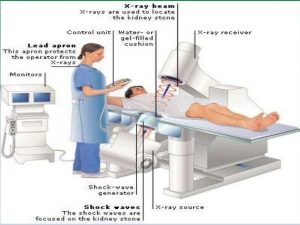
ESWL is easily done as an outpatient procedure and takes about 1 hour. The patient lies on a water-filled cushion and the stone localized by means of X-ray or ultrasound. Xray targeting is preferred but if the stone cannot be seen on the xray, then ultrasound localisation is used. Pethidine analgesia with sedation is injected as some 3000 to 4000 shocks of sound waves are needed to shatter the stone.
The patient lies on a water-filled cushion & the stone targetted using the xray unit of the machine
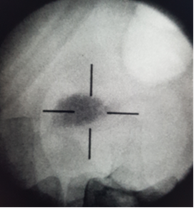
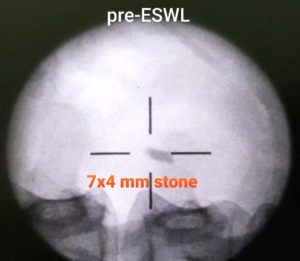
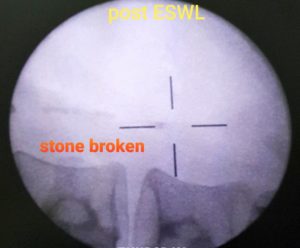
The stone breakage can be seen on xray images taken on the machine
A check xray and ultrasound is done 2 to 4 weeks later to confirm the outcome. Should there be any remnant stone > 5 mm, a second session may be needed.
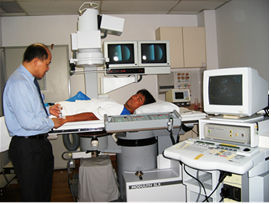
Dr Chin doing ESWL under xray localisation
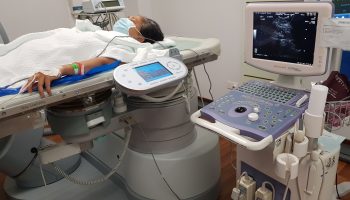
Under ultrasound Localisation
Complications include:
- bloody urine. This occurs for a few days only.
- colicky pain. As the stone fragments pass out, they can cause temporary blockage and pain. The pain can be so bad that the patient may require analgesic injections. Drinking plenty of water will help flush out these small stones.
- swollen kidney (hydronephrosis). If the stone fragments are still too big, they may get stuck along the lower ureter to cause hydronephrosis. If the swelling does not resolve, and accompanied by recurrent colic, a double-J stent may need to be inserted to unblock the kidney and relieve the pain.
- urinary tract infection (UTI). This is due to release of bacteria within the stone.
- kidney haematoma. This can occur with ESWL for kidney stones. It is usually small and resolves. Large haematomas take longer to resolve and tends to cause loin pain and fever. Antibiotics are given to prevent infection of the blood clot.
Desired Outcomes:
- no colic
- no large haematoma (<1% risk)
- no UTI
- stone fragments < 3 mm